


Project developers usually pick a validation and verification body (VVB) the way they pick any vendor: availability, price, and whoever did the last one. For a project where spatial modeling and uncertainty sit at the center of the quantification, that choice can strongly affect how effectively the project's SOC quantification is challenged, evidenced and defended through validation and verification. Here is what to screen for before the first call.
The question reaches us in a predictable form, usually from a developer moving to a new registry or taking a pilot into a real crediting pathway: can we keep the VVB who validated the last version? It is the cheapest option and the least disruptive one, and it is usually the wrong starting point, because the previous validation assessed a different program, methodology or quantification approach.
A VVB may be appropriately accredited for the sector while the assigned engagement team has limited experience with SOC sampling, spatial models or agricultural uncertainty. That matters because these projects require more than a documentation check: the team needs enough collective competence to assess whether the quantification approach itself is methodologically and statistically defensible.What follows is what to confirm before you shortlist, and the single conversation that tests most of it.
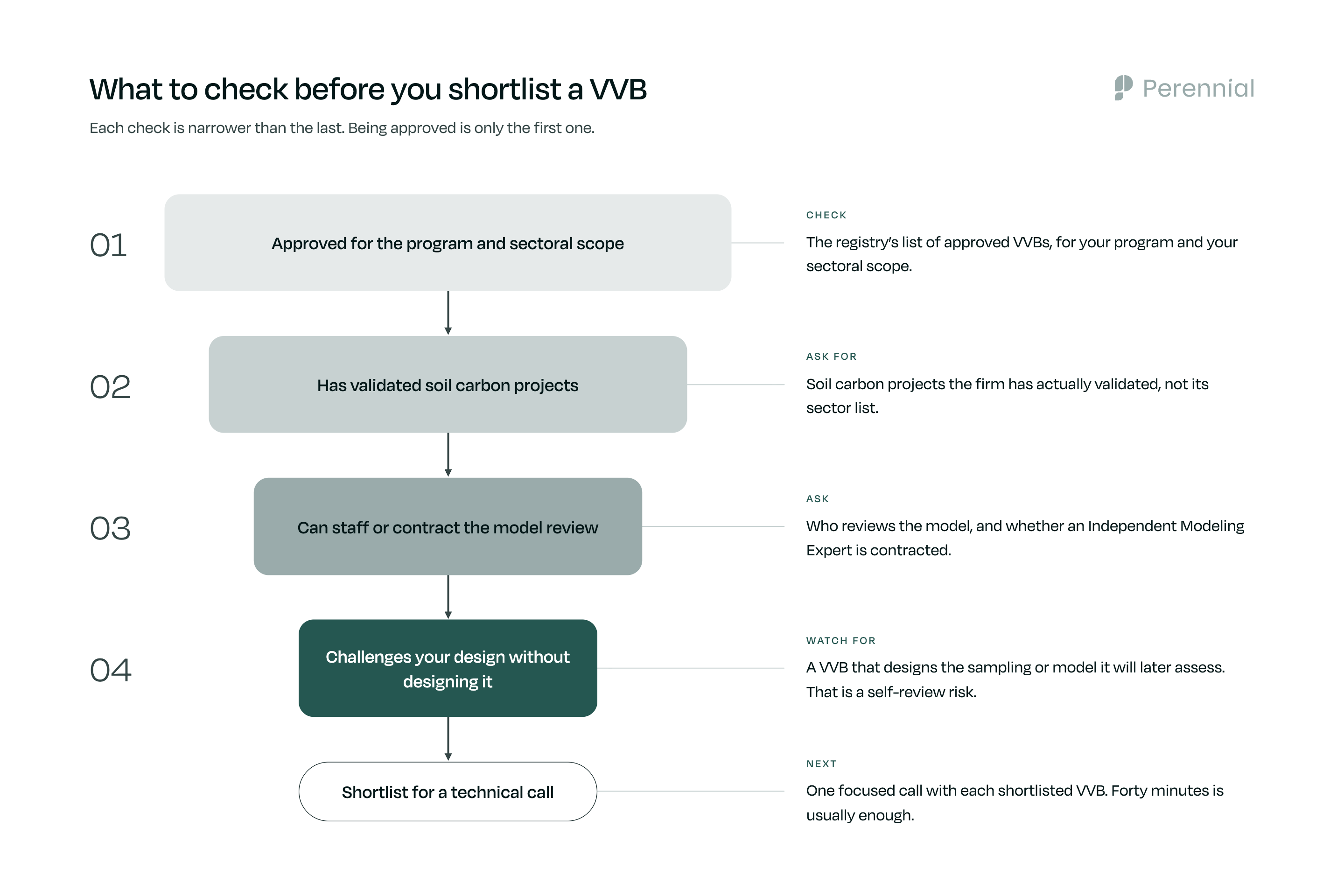
A VVB is an independent third-party auditor, approved by a carbon crediting program, that validates a project's design and verifies its reported emission reductions and removals. To choose one for a soil carbon project, check four things:
- It is currently approved under your program and sectoral scope.
- It has validated soil carbon projects before.
- It can staff or contract the competence to review your model.
- It challenges your design without designing it for you.
Then put each shortlisted VVB on one focused technical call.
Approval sits at program and sectoral level, not at methodology level
Every registry publishes which VVBs it has approved and for which sectors. The ICR directory is one example, and Verra, Gold Standard and the others maintain equivalents.
First confirm that the VVB is currently approved for validation and verification under the relevant program and sectoral scope. Then confirm that it can staff the specific technical competence your methodology requires, including VM0042 and VT0014 where relevant. Those are two separate questions, and the second one is where projects get caught out, because accreditation is granted at sectoral scope rather than for an individual methodology or tool.
Scope still isn't competence. Soil carbon audits turn on details that don't arise in other project types: whether the sample set represents the project area, how bulk density is handled and whether stocks are reported on an equivalent soil mass basis, laboratory QA/QC, and the applicable requirements for SOC remeasurement, model validation and true-up over successive monitoring periods. A team that hasn't worked through these will either miss them, which becomes a defensibility problem with buyers later, or raise them late, which becomes a schedule problem now. Ask for soil carbon projects the firm has actually validated, not its sector list.
The real test is whether they can assemble the right model-review competence
This is where most of the risk sits, and where the field is thinnest. If your project uses digital soil mapping (DSM) to produce SOC values, someone on the assessment has to be able to interrogate the model itself: whether validation is genuinely independent of calibration data, how spatial dependence between training and validation points is handled, whether prediction error and bias are quantified honestly, and how measurement error is propagated into total project uncertainty. That is a statistical review, which a documentation check does not cover. Wadoux et al. (2026), A digital soil mapping approach to soil carbon monitoring, reporting and verification (MRV) in npj Sustainable Agriculture, walks through that chain end to end: calibration, prediction, validation, spatial aggregation and the resulting uncertainty deduction (our summary of the paper).
That review doesn't have to sit entirely inside the core VVB team. For Verra projects it may include an Independent Modeling Expert (IME), a specialist approved by Verra who assesses the model's validation report. Under VMD0053, IMEs are contracted by the VVB as part of its evaluation of process-based biogeochemical models, and Verra has established a DSM-IME roster whose approved experts may similarly be contracted by VVBs to assess DSM model validation reports and issue evaluation reports. So the useful questions are how the VVB handles model assessment, who owns which part of the review, and how the technical expert's findings are integrated into the VVB's overall assurance conclusion. The VVB doesn't need to hold every skill itself.
The opposite failure is worth naming too, because it is easy to mistake for good service. A VVB should challenge the design, identify non-conformities and explain the applicable criteria. But if it starts designing the sampling strategy or model solution it will later assess, that can create a self-review or impartiality risk.
Which means asking who, specifically. Firms don't audit projects, people do, so ask which technical competence would be assigned to the SOC and model questions, who provides independent review behind them, and what comparable projects those people have worked on. A large assurance platform with excellent corporate credentials can still staff your project with a team that has never seen a soil carbon model. While you're there, ask what evidence package they expect before validation starts. The answer tells you how organized the process will be, and gives you a head start on assembling it.
One technical call will tell you more than any capability deck
Put each shortlisted VVB on a single focused call and use it to understand how they would structure the assessment: what competence they would assign, whether an IME is needed, what evidence package they expect, which technical areas they consider high-risk, and how findings are reviewed and closed. You want evidence that they understand the problem, without asking them to design the solution for you. Forty minutes is usually enough.
Then compare the conditions that decide your timeline. Working-hour overlap, and whether a live call is possible when a finding needs resolving. The VVB's technical review and independent decision-making structure, and how findings move through those stages, which is an assurance control, so don't treat it as a delay to minimize. Site inspection practicality across your geography. Continuity into verification, and whether rotation requirements will force a change later. And defensibility, which is easy to forget: if a buyer or a journalist examines this project in three years, the evidence behind the numbers has to hold up under that scrutiny too.
Technical fit decides whether the assessment is any good, execution conditions decide when it finishes, and both are knowable before you sign anything.
Why technical fit shows up in your deductions and your timeline
Under methodologies such as VM0042, quantified uncertainty can directly affect the deduction applied to reported emission reductions and removals, which gives the uncertainty analysis a commercial consequence as well as a technical one.
A team that understands model-based quantification will assess your treatment of it on the merits. A weak technical fit can instead lead to avoidable findings, repeated clarification rounds, disagreements over uncertainty treatment and longer review timelines.
Common questions about VVBs for soil carbon projects
What is a VVB?
A validation and verification body (VVB) is an independent third-party auditor approved by a carbon crediting program. It validates a project's design and verifies the emission reductions and removals the project reports.
Does a VVB need to be approved for VM0042 or VT0014 specifically?
No. Registries approve VVBs by program and sectoral scope, not by individual methodology or tool. That is why you need to check separately that the assigned team has soil carbon and model-review competence.
What is an Independent Modeling Expert?
An Independent Modeling Expert (IME) is a specialist approved by Verra and contracted by the VVB to assess a model. Under VMD0053 that covers process-based biogeochemical models. Under VT0014, a DSM-IME assesses the DSM model validation report.
Can a VVB help design my sampling or model?
No. A VVB should challenge the design, identify non-conformities and explain the applicable criteria. If it designs the sampling strategy or model it will later assess, that can create a self-review or impartiality risk.
Where Perennial fits
Perennial is an end-to-end MMRV (measurement, monitoring, reporting, and verification) company delivering registry-aligned, outcome-based measurements for any crop, any land use, anywhere in the world. We led the development of VT0014, the Verra-approved tool for quantifying soil carbon using digital soil mapping, and we support project developers in preparing for validation and verification. That includes preparing the technical evidence package, documenting model and uncertainty procedures, maintaining traceability between data and reported results, and responding to VVB and IME findings.
We don't select your VVB, and we sit on the quantification side rather than the assurance side. What we can do is tell you which questions a serious assessment will raise, and make sure the project has answers before anyone raises them. If you're weighing a registry change or a methodology update, the audit implications are worth walking through first.
Learn more about Perennial's MMRV →
