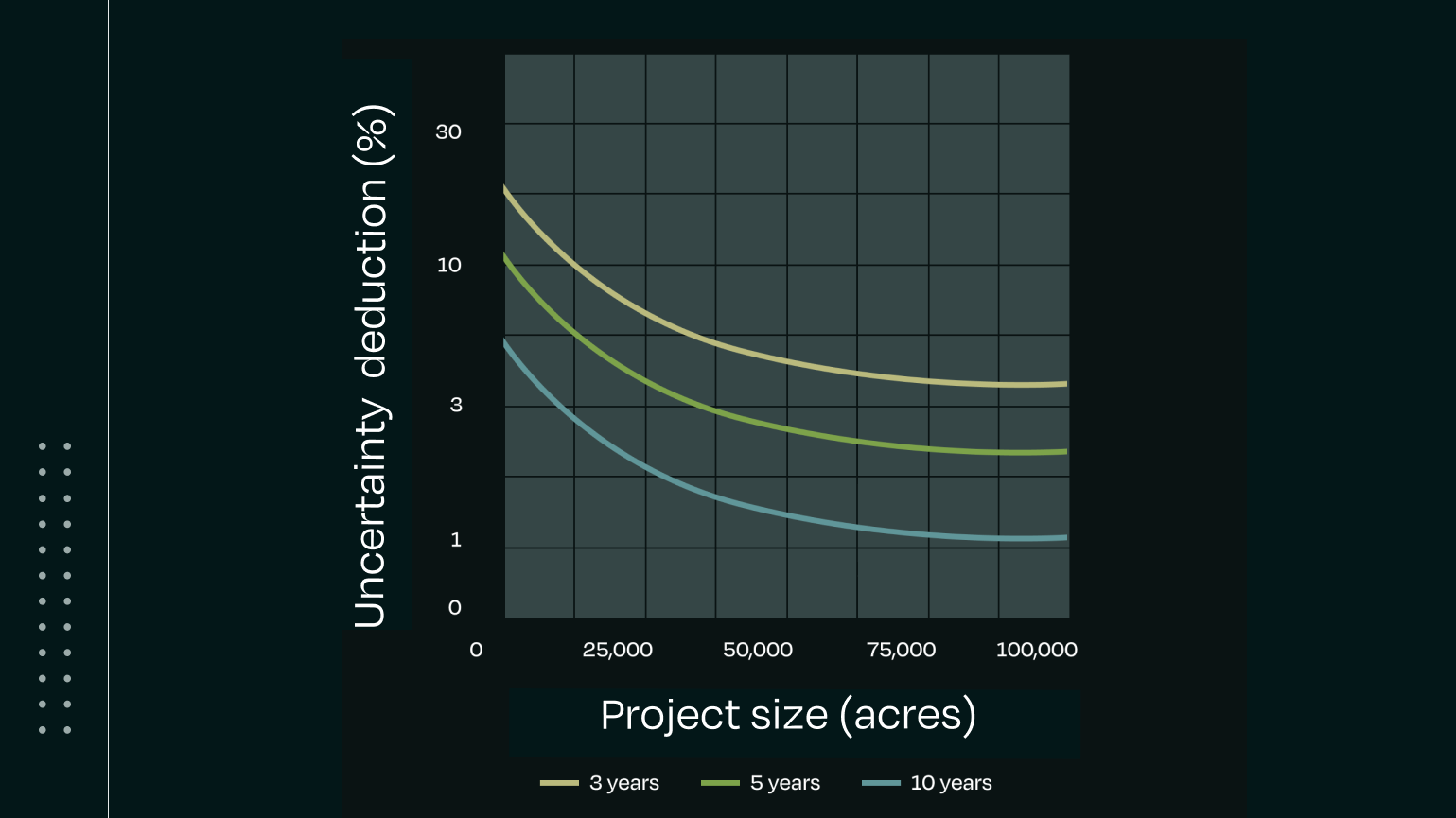
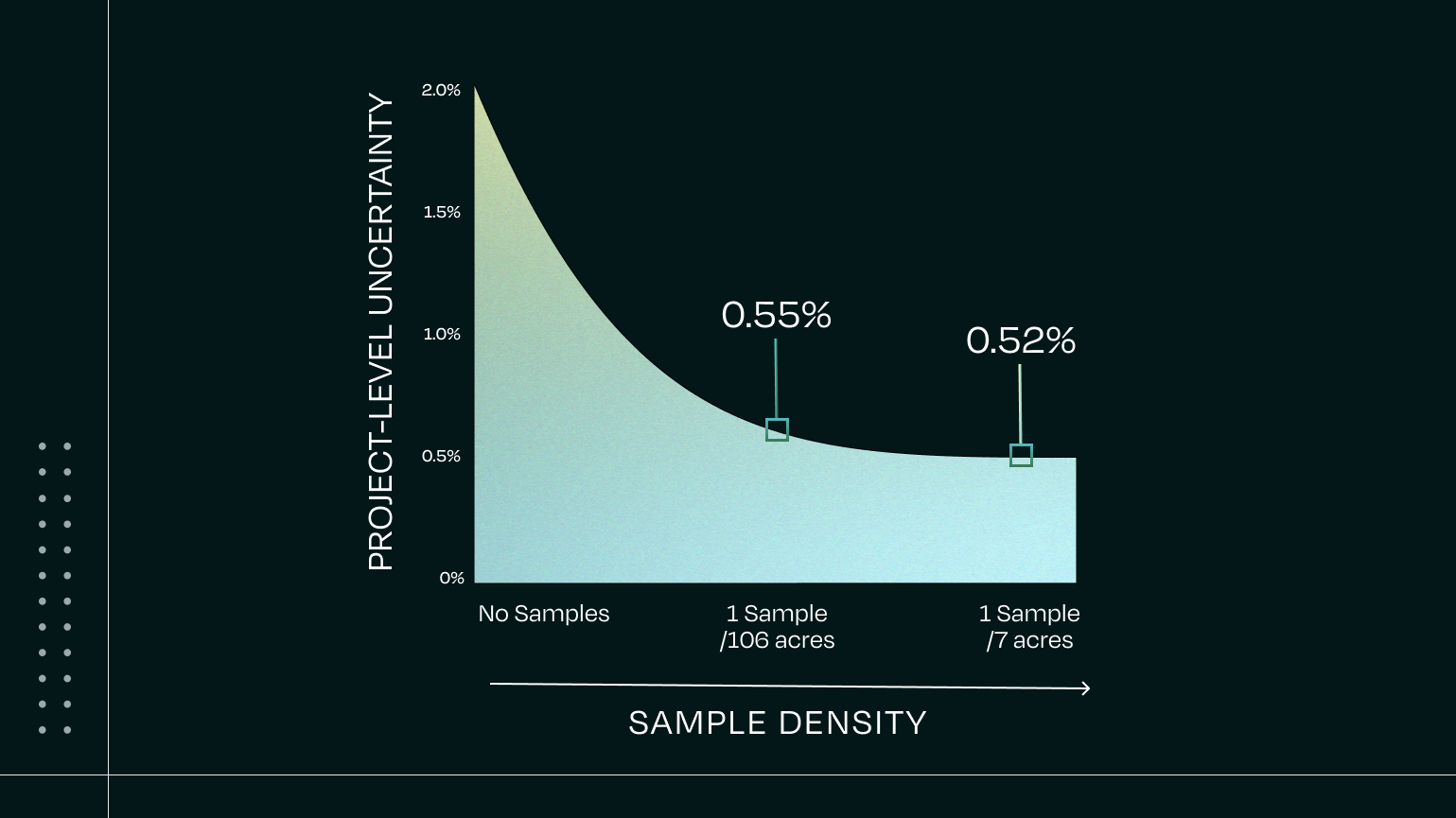
Project developers with validated VM0042 projects are asking how to bring digital soil mapping (DSM) into monitoring that was designed around soil cores and biogeochemical models. Done well, the switch cuts the samples a project has to collect and lowers its uncertainty, which means smaller deductions and more saleable credits from the same fields. Below are the questions we hear most, on deviations, mixed quantification units, stratification, uncertainty and true-up, with our current answers.
VT0014, the Verra-approved tool for quantifying soil carbon using digital soil mapping, opened a path that didn't exist when many VM0042 projects were validated: using DSM predictions to reduce sampling. Our peer-reviewed study in PLOS ONE sets out how far that sampling reduction can go without losing accuracy. For projects already underway, the question is rarely whether DSM is allowed.
You can't bring DSM into a validated project without disrupting the monitoring plan to some extent. Any deviation in monitoring procedures from what the validated monitoring plan sets out is a project description deviation, and it has to be assessed and accepted by the VVB at the verification event covering the period in which the deviating procedures were applied. Monitoring with DSM when DSM wasn't in the original plan will trigger that procedure.
The work, then, is to understand the domino effect before you start: how many dominoes fall, which deviations you need, and how to keep the SOC quantification logic clear while the measurement technique changes.
Do T0 and T5 have to use the same measurement technique?
There is a route to a switch. Where a project adopts a new eligible method as part of adopting a new version of the methodology, for example a proximal sensing method under Appendix 4, the proponent or its technical service provider has to show that previous measurements and new remeasurements are comparable, and justify any conversion factors used. A project validated on VM0042 v1.0 with dry combustion can update to v2.2 and move to DSM on that basis, with the justification written out.
There is a second question underneath this one: whether dry combustion samples at T0 and digital samples at T5 can be used together for biogeochemical model true-up under VMD0053, given they come from different measurement techniques. We think they can. Long-term research trials have moved from Walkley-Black to dry combustion mid-series, so the idea isn't new. It still needs to be worked through properly on the technical side. VM0042 and VMD0053 aren't fully aligned here, and where they differ, the methodology language usually takes precedence.
Whatever the methodology allows or implies, a measurement approach that isn't in the validated monitoring plan has to be handled through a deviation. You document what changed, when, why, and why the project is still in conformance. The VVB assesses the deviation and reports its findings in the verification report, and the deviation is carried forward in subsequent monitoring reports. Verra's role is to review the VVB's work.
This isn't theoretical for us. Perennial has worked through transitions like this before, building on sampling and stratification designed by other providers, and stepping in for projects whose previous measurement arrangements ran into problems.
Can new fields use DSM while existing fields stay on soil cores?
Yes, but the question hides two different designs, and they get accounted for differently. Be precise about which one you're proposing.
The first is different quantification approaches in different quantification units. VM0042 v2.2 allows more than one quantification approach for a given gas and source, as long as the same approach is used for a given quantification unit in both the project and baseline scenarios. Subdivisions of the project area using different approaches have to be stratified and accounted for separately, and a project can switch between allowable approaches during its lifetime on the same condition. In practice this is close to running two projects inside one, each with its own quantification and calculations, and its own uncertainty, leakage and non-permanence deductions.
The second is one quantification approach across the whole project with different SOC measurement techniques underneath it. Quantification Approach 1 with BGCMs everywhere, but DSM initializing and truing up the model in some quantification units while soil cores do it in others. This is likely justifiable. What's less clear is the uncertainty accounting. It may be possible to work out a single uncertainty term applied at project level, but it's harder to defend and harder to explain, and separate accounting may turn out to be required here too.
Either design needs explicit documentation of how DSM-related error enters some quantification units and not others. Have that conversation with your VVB early, not at the verification event.
Does DSM require redefining our strata and quantification units?
Not for the modeling. Where a project has already defined how modeling points (sample units) are determined and how quantification units are drawn, that structure can stay as it is. An existing setup with the sample unit as field and the quantification unit as farm remains valid, and using DSM to initialize and true up a biogeochemical model run on a point basis doesn't change it.
Physical sampling does change. A new layer of sampling is added, separate from the modeling structure, and it exists specifically to calibrate and validate the DSM. The samples are still collected. Their job is different now.
That leaves the project with two distinct sampling frameworks:
- Physical soil sampling for DSM calibration and validation, governed primarily by VT0014 and aimed at DSM model performance.
- "Digital" soil sampling, pulling SOC values from the mapped DSM predictions, governed by VM0042 and used for BGCM initialization and true-up.
The two don't have to be identical, and arguably they shouldn't be, because the sampling is serving different purposes.
How does DSM change the uncertainty calculation?
VM0042 error propagation under Quantification Approach 1 still considers the same three sources: BGCM model prediction error, sampling error, and measurement error. With dry combustion samples, measurement error is assumed to be zero. With DSM predictions, it has to be addressed explicitly.
Using DSM values at point locations to run BGCM simulations falls under Use Case 1 of VT0014, with the model run on a point basis. Measurement error from DSM predictions is treated the same way as soil spectroscopy: propagated into the sampling error term through Monte Carlo simulation, drawing SOC stock values from the DSM predictive distribution at each sampling point. Our current expectation is that where DSM is used at only one time point, the simulations use the prediction distributions at that time point only.
BGCM model prediction error can still be estimated analytically or via Monte Carlo, then combined with the sampling and measurement error terms to get the total variance of the SOC pool.
One thing to watch: VM0042 v3.0 is expected to allow BGCM simulations on an area basis. That would mean propagating DSM error differently, using the Wadoux-Heuvelink method in VT0014. Projects could still run the BGCM on a point basis, and everything above would still apply.
What happens at true-up?
Soil cores at T0 and DSM-derived SOC estimates at T5 give you observed SOC stock change estimates for the model validation dataset, and VMD0053 is then followed as usual to update model prediction error terms. This is the first question again in a different place. VMD0053 can accommodate the mix, VM0042's latest text is stricter, and the comparability justification described above is what carries it.
There is one DSM-specific consideration: pooled measurement uncertainty. VMD0053 v2.0 says that studies using different measurement techniques at different time points should be conservatively excluded from both groups of studies, so some observed data might need to be excluded from PMU calculations to avoid commingling uncertainty from different techniques.
Incorporating DSM isn't expected to change the cumulative accounting procedures in VM0042 v2.0+.
Is there a cleaner way to do this?
Mixing measurement techniques across time points carries legacy effects with it, mostly in uncertainty and error propagation. There may be a way to avoid them.
If the original T0 soil cores are fit for purpose, it may be possible to train DSM models retroactively on those samples for each quantification unit, producing DSM-based SOC predictions at each cohort's T0 date (assuming a grouped project). Every time point then runs on DSM predictions at point-based digital samples: initialization, recalibration and true-up.
For point-based modeling, this could retroactively increase the effective number of sampling and modeling points at T0 and at each remeasurement, because DSM produces wall-to-wall SOC estimates at every measurement event. That reduces sampling error under Quantification Approach 1.
The approach takes additional justification and carries some risk. In exchange, the project transitions fully to DSM with no legacy from non-DSM T0 measurements, and fewer inconsistencies to explain over the monitoring life of the project.
When should a project make the switch?
Earlier is better. Incorporating DSM before validation avoids deviations entirely and keeps project design and monitoring consistent over the life of the project.
If validation has just started, and it's feasible, it's worth pausing to incorporate DSM now, weighing VVB contract terms and VCS deadlines such as the five-year validation window for most ALM projects.
If validation is nearly complete, our recommendation is to finish it as designed and then adopt DSM through a deviation afterward. Pausing this late usually means re-doing big parts of the work, a cost that rarely beats a clean deviation after registration.
If validation is complete, adopt DSM through a project description deviation. Projects on VM0042 v2.0, which predates VT0014, will likely also need a methodology deviation, or can update to v2.1+ through the deviation process instead.
Whichever scenario fits, the transition doesn't start from a blank page. Perennial has prepared language for each section of the project documentation that needs to change, and supports the project developer through the deviation process end to end.
Where Perennial fits
Perennial led the development of VT0014 and works with project developers on these transitions: scoping whether point-based or area-based modeling fits the project, designing the calibration sampling, and documenting the deviation for the VVB. If your validated project is weighing DSM, the design conversation is worth having before your next verification event.